Showing posts with label Frequently Misused and Misspelled Words and Phrases. Show all posts

Tuesday, November 25, 2014

Frequently Misused and Misspelled Words and Phrases (and how to use them correctly) is available for preorder


From the author of the former #1 bestselling Military Sci-fi novel on Amazon (My Other Car is a Spaceship). FREQUENTLY MISUSED AND MISSPELLED WORDS AND PHRASES (and how to use them correctly) is now available for preorder on Amazon.

Do you sometimes find yourself using the wrong word (such as discrete vs. discreet), or using a word incorrectly? Are you confused by the differences between similar words (such as shined, shone, and shown; lay and lie; or to, too, and two)? Do you misspell common words (alright vs. all right, or ect. vs. etc.) and phrases (such as tow the line vs. toe the line)? Do you write fiction, nonfiction, business memos, emails, or anything else that others will read? Then this book is for you.


It explains in simple language the differences between words and phrases that are frequently misused and misspelled, as well as rules for proper punctuation and capitalization, and other elements of English that often trip up the unwary writer. And it does so with frequent humor to keep it from becoming too dry. For example:

Baited vs. Bated
Wrong: I waited with baited breath.
Right: I waited with bated breath.

Do your friends call you “fish-breath”? If not, then you wait with bated breath, which means “reduced, lessened, lowered in force.” The expression bated breath (using a short form of abated) refers to how someone almost stops breathing through awe, terror, anxiety, or extreme anticipation. Perhaps you waited with bated breath as he baited the hook.

and:

Dessert vs. Desert
Wrong: She wandered for days, lost in the dessert.
Right: She wandered for days, lost in the desert.

Unless she was eating the world’s largest hot fudge sundae, she was lost in a desert (an extremely dry place that supports only sparse vegetation), not a dessert (the final course of a meal).

and:

Site vs. Sight vs. Cite
Wrong: Check out my web sight.
Right: Check out my web site.

A site (noun) is a location. (“This is the site of our upcoming restaurant.”) A sight (noun) is a vision or a glimpse of something. (“She was quite a sight in that dress.”) Cite isn’t even a noun, it’s a verb. It means to quote as an authority (“Cite your sources.”), to commend for outstanding service (“He was cited for bravery.”) or to summon to court (“She was cited for speeding.”). The noun form of cite is citation. (Isn’t it interesting how a citation for bravery can be a good thing while a citation for speeding is a bad thing?)

and:

Tact vs. Tack vs. Tactic
Wrong: I’m going to take a different tact on this problem.
Right: I’m going to take a different tack on this problem.
Right: I’m going to try a different tactic with this problem.

The phrase “taking a different tack” comes from nautical terminology meaning a course run obliquely against the wind in a zigzag fashion. So, taking a different tack means to try another approach or come at the problem from a different direction. Tact, on the other hand, is a sense of what’s appropriate or a skill with delicate situations. A tactic is a plan or procedure to attain a goal. A person of tact, then, might try a different tack as a tactic for achieving victory.
Check out the Look Inside feature for hundreds of other examples.

FREQUENTLY MISUSED AND MISSPELLED WORDS AND PHRASES (and how to use them correctly) is available on Amazon in 12 countries: http://hyperurl.co/FrequentlyMisusedWrd. To find out more about my books, go to my website: http://MarkTerenceChapman.com.

Sunday, November 23, 2014

Lots of good stuff going on....

I know I'm way behind in  updating this blog, but I've been really busy. So, here goes:

1) My Other Car is a Spaceship is nearing 11,000 copies sold.

2) The audiobook version of My Other Car is a Spaceship is on schedule to ship in early December. It will be available via Amazon, Apple iTunes, and Audible.com.

3) My Other Car is a Spaceship will also be available as an ebook from Barnes and Noble, Apple iBook, Oyster, Scribd, txtr, Smashwords, and other retailers, as well as distributors that sell to over 20,000 libraries, on December 5.

4) The Mars Imperative and The Tesserene Imperative will be combined into one ebook volume called The Imperative Chronicles (Books One and Two). It will be released on December 6.

5) My self-help book for writers of all types, Frequently Misused and Misspelled Words and Phrases (and how to use them correctly), will be released on December 5.

Whew! December will be insane. (In a good way.) :)


Monday, August 18, 2014

Frequently Misused and Misspelled Words and Phrases, part 93

From my upcoming book, Frequently Misused and Misspelled Words and Phrases (and how to use them correctly).

People vs. Peoples vs. Persons

Wrong: The many people of Africa offer diverse cultures.
Right: The many peoples of Africa offer diverse cultures.

Wrong: The incredibly huge number of peoples in India leads to economic hardship and health problems.
Right: The incredibly huge number of people in India leads to economic hardship and health problems.

Wrong: We’re hunting for three specific people who escaped from jail.
Right: We’re hunting for three specific persons who escaped from jail.

The word people refers to a group of human beings in a general sense. But a people is used for a body of people sharing a similar culture. When discussing multiple such bodies of people, use peoples. Persons is a plural of person, naturally, and refers to particular individuals, even if unidentified (as in “person or persons unknown”).

Sunday, August 17, 2014

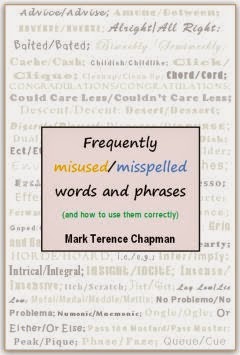
The cover for Frequently Misused/Misspelled Words and Phrases (and how to use them correctly)

Here is the cover of my upcoming self-help book for all types of writers (fiction/nonfiction/business/emails, etc), Frequently Misused/Misspelled Words and Phrases (and how to use them correctly).


What do you think of it?

Sunday, August 10, 2014

Frequently Misused and Misspelled Words and Phrases, part 92

Wrong: He snuck in through the back window.
Right: He sneaked in though the back window.

Sneak is the past tense of sneak (to move surreptitiously). Snuck is simply a nonstandard variation. It is used quite often in dialog to give the speaker a certain relaxed vibe. But it shouldn’t be used in formal writing.

Saturday, August 9, 2014

Frequently Misused and Misspelled Words and Phrases, part 91

Udder/Udderly vs. Utter/Utterly

Wrong: That’s udder nonsense!
Right: That’s utter nonsense!

Wrong: She was udderly oblivious to the destruction behind her.
Right: She was utterly oblivious to the destruction behind her.

Don’t laugh! I’ve seen this entirely too many times. An udder is the large baglike mammary gland (teat) of female cows, sheep, goats, and other four-legged mammals. Udderly isn’t even a word.  Utter has several meanings, including (as a verb) to produce audible sounds or speak, and (as an adjective) complete, total, or unconditional. Utterly is an adverb meaning completely, totally, or absolutely. This is a case where “udder nonsense” is utterly nonsensical.

Friday, August 8, 2014

Frequently Misused and Misspelled Words and Phrases, part 90

Foo-pa vs. Faux pas
Wrong: Did you hear about her foo-pa at the gala last night?
Right: Did you hear about her faux pas at the gala last night?

Faux pas (pronounced FOH-pa) is a French term (literally “false step”) for an embarrassing social blunder or slip in manners, etiquette, or conduct. In the above example, it was the speaker who committed the faux pas.

Tuesday, August 5, 2014

Frequently Misused and Misspelled Words and Phrases, part 89

Literally vs. Figuratively
Wrong: I was literally buried under paperwork yesterday.
Right: I was buried under paperwork yesterday.

Wrong: Having a baby literally ended her life.
Right: Having a baby ended her life, figuratively speaking.

Literally means actually. Therefore, unless a huge pile of papers actually toppled over and trapped you beneath it, don’t say literally. If that was what happened, you might be advised to wear a medical alert bracelet so the search-and-rescue team can find you, in case it ever happens again—or change to a safer job.
If you’re not speaking literally, but using a figure of speech or metaphor, then say figuratively.

Monday, August 4, 2014

Frequently Misused and Misspelled Words and Phrases, part 88

Here's another one:

Expresso vs. Espresso
Wrong: I like to start every morning with a strong shot of expresso.
Right: I like to start every morning with a strong shot of espresso.

Espresso is a delicious hot beverage with quite a caffeine kick. Expresso isn’t. In fact, it’s nothing, not even a real word. So don’t use it.

Sunday, August 3, 2014

Frequently Misused and Misspelled Words and Phrases, part 87


From my upcoming book by the same title.

Eldest vs. Elder
Wrong: The eldest of their two daughters is getting married next month.
Right: The elder of their two daughters is getting married next month.

Use elder when referring to one of only two; use eldest when referring to one of three or more.

Later!

Saturday, August 2, 2014

Frequently Misused and Misspelled Words and Phrases, part 86

I've decided to resume posting bits and pieces of my upcoming book by the same name. No idea when it'll be done. It currently has over 250 entries. I'll have to decide when there are enough to publish.

Allude vs. Refer
Wrong: She kept alluding to the particulars of the annual report.
Right: She kept referring to the particulars of the annual report.
Right: Mr. Kellar frequently alluded to the neighborhood where he grew up.

We refer to something directly or allude to it indirectly. (Sports commentators, for some reason, seem to misuse allude frequently.) Rather than saying a woman has put gained a lot of weight late in her pregnancy, we might allude to this by saying she’s “very pregnant.”

More later.